
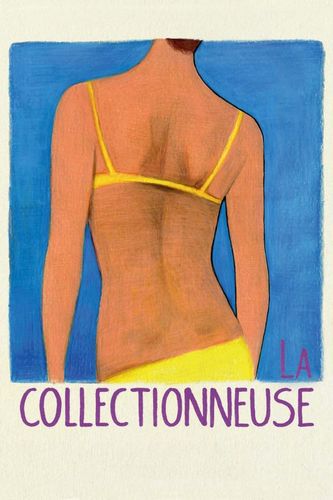
La collectionneuse (Éric Rohmer, 1967)
Many of the films of Éric Rohmer are marked by his distinguished sense for the ease of summer breaks, which sets the framework for both his visual characteristics and that special web of light yet overcomplicated conflicts, reminding one of 18th century comedy of errors. The beauty of a dress’ colours and textures, the sensual pleasures of wind, water and scents of beaches and nature, the immaculately articulated verse and virtuoso dialogues are all inseparable from this carefully designed world. Through its nonsensical and hilarious voice-over narration, La collectionneuse, in particular, offers a deeply revealing construction of the described universe. While being one of the most amusing films I have ever seen, how it reminded me of Laura Mulvey’s Visual Pleasure and Narrative Cinema intensified its intellectual richness.
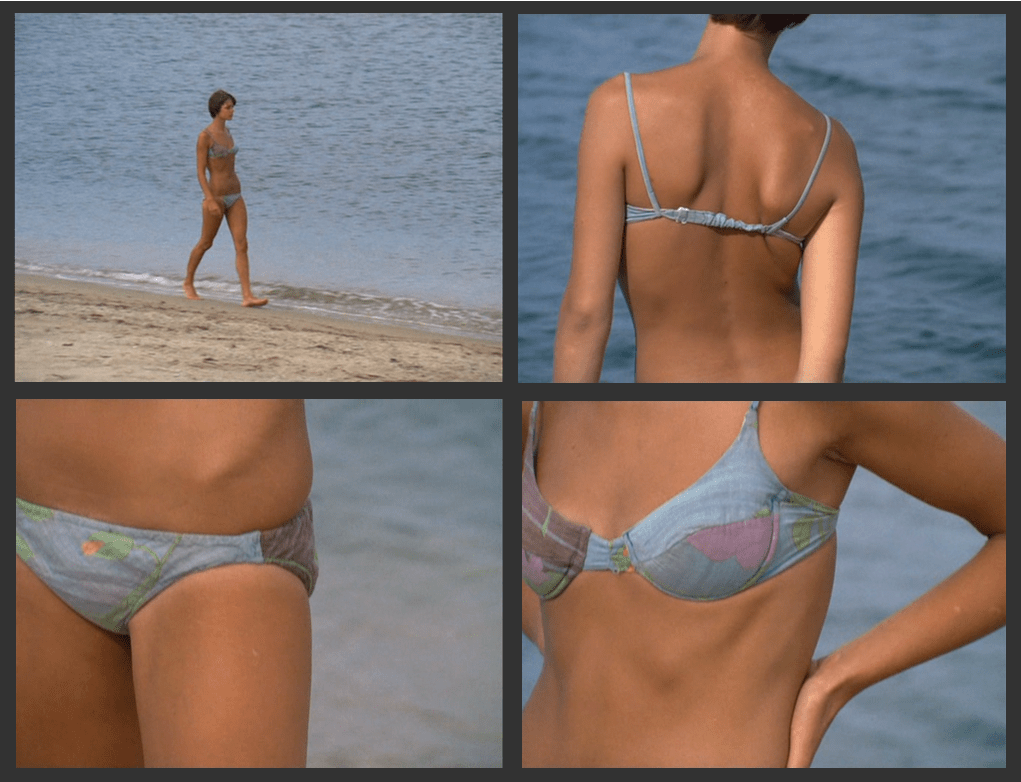
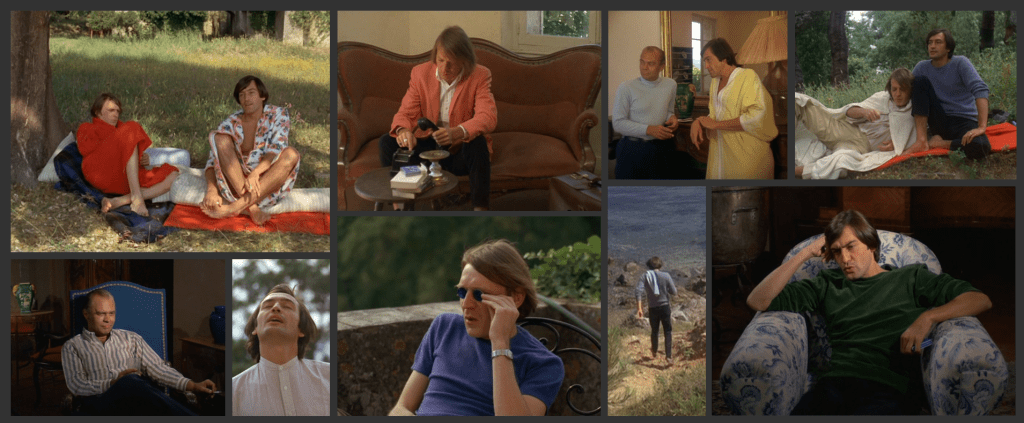
From the first moments of the film, clarity and straightforwardness dominate in an openly self-reflective yet classically fluid style at once. In the prologue, harshly cinematic and antiquely theatrical, each protagonist is introduced via their one signature quality. Haydee is the perfect porcelain body walking along by the sea like a mannequin, Daniel is the posing pseudo-artist symbolized by the quasi-spirited bluff artwork covered by blades and Adrien, the wise womanizer, who lives in the cult of beauty and remains unaffected by female manipulation. In a typical Rohmer image, the actor is positioned, most comfortably for the spectator, in the middle of the composition, resulting a sense of wild openness. In dialogue scenes, actors sit next to each other facing towards the audience, never turning their back on the camera. The plainness is of course juxtaposed to Rohmer’s matchlessly icy irony, since all this is fakery, the characters perform playful fraud to convince themselves and each other about pretentions that do not exist. An obvious case of pretence is how Adrien likes to demonstrate his intellectual superiority. For him, everything is heightened to a philosophical degree. Justifying his noble laziness and desire to do nothing, he directly shows a book by Rousseau to the camera. In the next scene, he, the reminiscent of the great outcast, wanders out into the nature. Reading, of course, ceases to happen. Adrien, joining Daniel in campy robe, discusses the overwhelming difficulties of accomplishing utter idleness.
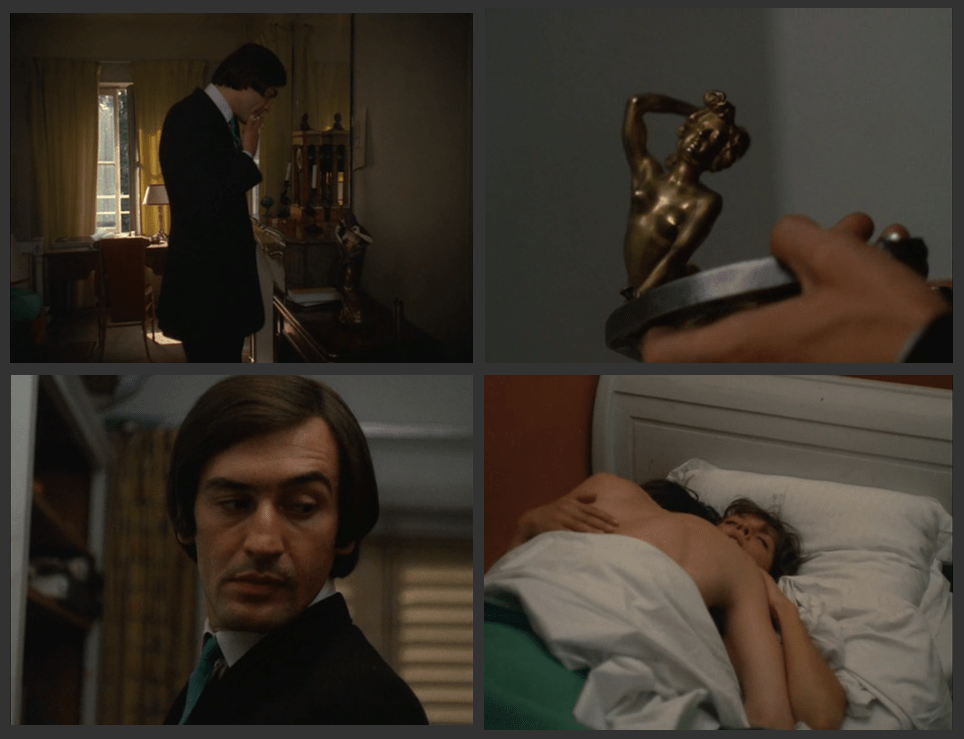
I understood the weight and complexity of how Rohmer ridicules these mannerisms when I connected the film and the Mulvey essay in my mind. In the beginning, the body of Haydee is fragmentized, and Adrien’s prologue establishes his gaze as the basis of the dramaturgy. Strolling around in the house of a friend, he observes statuettes depicting naked women, and right after that, he notices Haydee having sex – this is their first encounter. The prologues come to an end; Adrien’s narration starts. The film demands identification with him, telling the story exclusively from his viewpoint and interpreting it through his wit and commentary. “Traditionally, the woman displayed has functioned on two levels: as erotic object for the characters within the screen story, and as erotic object for the spectator within the auditorium, with a shifting tension between the looks on either side of the screen.”[1] As Mulvey states here, the viewer’s gaze is inseparably fixed to Adrien’s – the humour of the film originates in the very nonsense of this tie, a tie to a false and artificial self.
The image of Haydee is only presented as a mere construction of Adrien’s gaze and narration. Apart from the usual girl-hunt, Adrien’s objective is to define and describe Haydee, he even comes up with the nickname, la collectionneuse, which stands for man-collector. “Woman then stands in patriarchal culture as signifier for the male other, bound by a symbolic order in which man can live out his fantasies and obsessions through linguistic command by imposing them on the silent image of woman still tied to her place as bearer of meaning, not maker of meaning.”[2] Women are the intellectual creation of men’s fantasy, which is also related to another problem described by Mulvey. In the film, the representation of castration anxiety stands out in its nuanced reflexivity and it is the monopole factor in man-woman relationships.
Throughout the film, Adrien insists that Haydee adores him and that he is completely uninterested in that. He even acts as if he had to forcefully convince himself to seduce the girl. Failing to achieve that, he must find explanations and in doing so, he entirely complies with Mulvey’s description: “[…] preoccupation with the re-enactment of the original trauma (investigating the woman, demystifying her mystery), counterbalanced by the devaluation, punishment or saving of the guilty object (an avenue typified by the concerns of the film noir) […].”[3] Daniel remains somewhat of a peripherical figure in the film. Yet, he too condemns Haydee and in order to protect his own ego and superiority, often refers to the girl’s unimportance, just like Adrien. As for punishment, it gains significance at a later point in the narrative.
Haydee is being treated as a fetish object all along, which is the second form of escaping the anxiety as described by Mulvey: “complete disavowal of castration by the substitution of a fetish object or turning the represented figure itself into a fetish, so that it becomes reassuring rather than dangerous (hence overvaluation, the cult of the female star).”[4] Overvaluation itself takes place as Daniel and Adrien even before Haydee’s arrival preoccupy themselves with the fear of the girl ruining the vacation. In the last episode, objectification and the abovementioned punishment goes hand in hand for the punishment is making her an object and presenting it to Adrien’s supporter, the art collector – with whom and Haydee, a collector herself a parallel clearly emerges. The irony reaches its maximum when Haydee crashes an antique – and supposedly highly expensive – vase. It reveals the depthless and surficial posing of the men, their non-existent relation to the artworks, which are interchangeable for them and it shows how the whole situation is a play for Haydee. This, and the former break-up scene disambiguate the great distance between Haydee’s reality and the boys’ traps. Her freedom, integration and self-assurance make the audience sympathize with Haydee, as she seems to enjoy remaining on the outside of men’s pointless obsession and not letting judgement affect her.
The first punishment brings grave suffer for Adrien and leads to another one. In the last sequence, Adrien leaves Haydee behind on the road intending to break free from her and by that, rejecting her. It does not seem to bother Haydee. While he claims this to be the first real decision in his life, in reality, he is pushed by another, honking car and also the vacation comes to end. This period of time is typical of Rohmer, partly because of the summery colours and aroma and partly because he implements the specifics of vacation, its separate existence from daily life.In this film, vacation strengthens the ridicule and questions the sincerity of Adrien’s Rousseauian desire with cool acuity. Vacation explains how it is a parenthetical part of his life, not a way of living but a privilege. He sees the desertion of Haydee as the key to accomplish his philosophical ideas of an optimal being – yet, not much time passes when he phones Nice to book a flight to London to visit his ex-lover.
[1] Mulvey, Laura: Visual Pleasure and Narrative Cinema. In: Visual and Other Pleasures. New York: Palgrave, 1989. p. 19.
[2] ibid. p. 15.
[3] ibid. p. 21.
[4] ibid.

 Babos Anna