
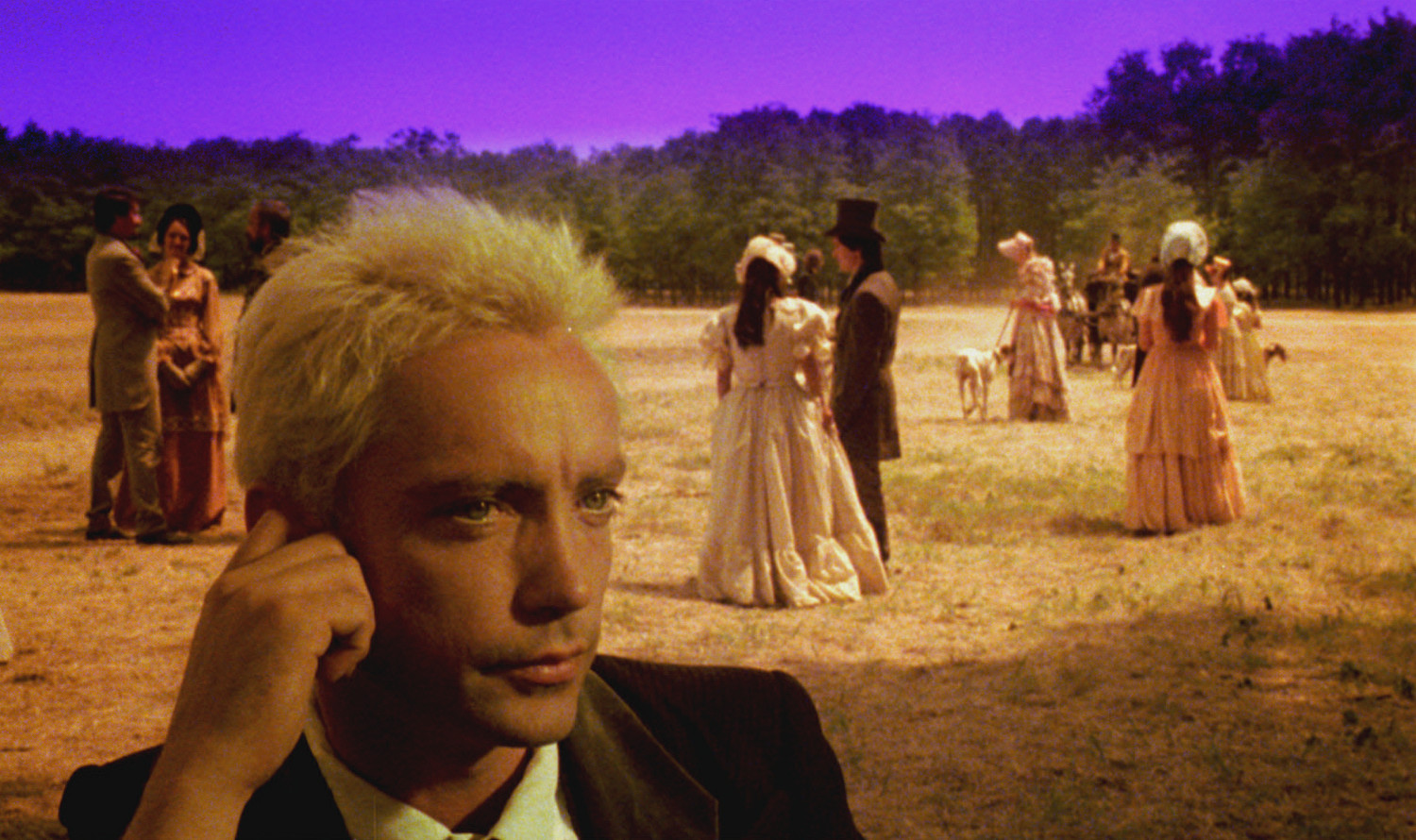
In 1972, the oeuvre of Lónyay Erzsébet, an unknown Hungarian poetess from the XIX. century, was finally published under the title of Psyché. Shortly afterwards, it turned out that the whole figure of Lónyay was created by Weöres Sándor, a famous Hungarian poet, who had always been attracted to the era of enlightenment. The fraud could hardly be noticed, since containing diary excerpts, poems and other supplements the structure of the book was authentic enough to trick readers.
When Bódy Gábor in 1979 decided to adapt the book, he must have been influenced by this iconoclastic gesture of Weöres and the kind of structural curiosity mentioned above. Bódy himself was always looking for new techniques in his most preferred artform, filmmaking, and he found Psyché a perfect literary base to carry out his ideas. Besides that, as Kovács András Bálint highlights „Bódy was the first to recognize that the way of thinking essentially attached to motion picture will be basically defined by fractional and simultaneous database logic in the future”[1] so the fragmented structure of the Weöres volume also rhymed with the director’s concept. The shooting was financed by Hunnia Filmstudio and it had a prominently huge budget so it seemed that Bódy could realize all his special ideas he had in mind.
Among Hungarian films Psyché I-III. has a quite special relation with preservation and restoration practices. Primarily, because technical obstacles aggravated the process. In addition to that, its substance also seems to create some kind of standpoint regarding value preservation.
Technical Obstacles
Before its premier, the heads of film industry in the Hungarian socialist regime got frightened by the magnitude of the film, so they intervened in the editing procedure. According to the final decision, the original four-hour-version, which was planned to be distributed as a three-part series on television, had to be shortened and a two-hour-long cut was made for the cinematic premiere. This way the authority eliminated the politically problematic middle part presenting the liberal politicians from the Hungarian Reform Era, and Bódy had to rearrange all the shots for this shorter version. Moreover, this middle-part was hidden by the Hungarian Television and they gave it back only after the regime change, in 1990 to screenwriter Csaplár Vilmos. Despite this already abridged version, the last cut was only one and a half hour long, required for the international distribution, and it was called by Bódy the „western version” of the movie which „lacks philosophy.” Unfortunately, the original negative remained only from this version and the other parts were only available on tertiary copies.
The Hungarian National Film Institute started the digital restoration in 1994. Following the general principle of minimal intervention, the complete four-hour version was the basis of the restored Psyché I-III, even though Bódy hadn’t ever seen it on screen, so already at this point the question of the original might come into mind.
After this confusion about the compilation of the film, the archivists had to face difficulties generated by Bódy’s experimental shots – he used a lot of photographical tricks, light cuts and superimpositions creating a hyperfictional and intentionally anachronistic visual style. Furthermore, the Kodak EastmanColor raw material vigorously faded by its nature, so the reconstruction of an authentic visual style would not be possible without director of photography Hildebrand István.
Substance and Preservation
The preservation and restoration practices depend on the general principles and considerations of the institution applying them, and particularly film itself. Proceeding agendas based on the film would mean the attempt to figure out the original intention of the filmmakers. As it was already referred to, in case of Psyché I-III.,this unsolvable question could be avoided thanks to the fortunate cooperation of Csaplár, Hildebrand, and first assistant Bonta Zoltán.
Nevertheless, if it was not possible for some reason, archivists would have had to compare this film to other works in better state of the same director, or to films of the same era, character or worldview. Both of the projects would be hard to realize, primarily because of the constant renewal of Bódy and compared to other films it can easily be noticed that „Psyché is an artwork preceding and not least defying its age.”[2] As a result of this special position of Psyché I-III. in Hungarian film culture archivists had to find other bases to start the work with the film.
The story by Weöres Sándor and the adaptation by Bódy Gábor complicates things further by the artwork’s relation to authenticity, preservation and restoration ethics or practices. Bódy almost didactically emphasizes the different scales of the verse novel as he articulates his personal and artistic self-confession, and a universal story about decay. The latter issue might raise some considerable questions regarding the material of the film as well.
A simple and general statement about Psyché I-III. is that the main characters can be interpreted as eternal archetypes. Psyché symbolizes love, freedom and explicit corporality, the figure of Nárcisz embodies spirit and isolation, and baron Zedlitz stands for the material world and the ideology of order. Gelencsér Gábor also points out in his short review that „becoming visible form the pictorial formulation of the love scene between Psyché and Zedlitz, their personal story is placed on the stage of the universe.”[3] The obvious, almost ostentatious directorial gesture, that the actors do not advance in age is also connected to this universal nature of the story.
While apparently an unambiguous sign giving green light to any kind of restoration practice, it is also essential to stress the interpretation of Psyché I-III. as a decay story. The film follows the deperition of all the characters mentioned above, especially Psyché, whose destiny is her tragic love, than Nárcisz, who becomes a victim of his own narcissism and finally baron Zedlitz, who never reaches the happiness on Psyché’s side, and by the end, his balanced personality suffers drastic change and turns him into an aggressive beast. Hence, the storyline concentrates on destruction, devastation and decay are put in a universal context.
At this point the radical standpoint of Paolo Cherchi Usai is worthy of consideration. Since the modus vivendi of film is dying, any intention towards its preservation is useless, and the substance of Psyché I-III. enhances this view in particular. „The aim of each project of preservation of the moving image is therefore, strictu sensu, an impossible attempt to stabilise a thing that is inherently subject to endless mutation and irreversible destruction.”[4] The archivist, the curator or the academic could hardly resist this idea, and the formidable question would certainly emerge – should we not let the Psyché I-III. decompose, should we stop intervening?
Despite the seductive romanticism and the possible relevance of this question, it would be inconceivable in the culture where film was born. From the emergence of museums in the XIX. century, culture is based on the relation towards our own past, our cultural heritage, which relation can be defined by collection, systematization and preservation. Given the solidity of this cultural context the leeway of archivists is quite limited but this dilemma should always be reflected upon.
Besides, given the already planned 4K restoration of the film,[5] these aspects should be even more intensely discussed. This way Psyché I-III. would have to adapt not just to the expectations of the actual audience but also to the recent trends and visual styles of the international festival market. Although we might be optimistic about the future of it, it is necessary to take the need articulated by international archivists into consideration, „»get back to basics« – the field’s founding days where film was art, not heritage.”[6]
Presentation of the Restored Psyché I-III.
The self-reflection of archivists and the exposal of the background of the changes carried out on the material is crucial to certify their own work and to make all the obstacles and difficulties of the restoration available for the critics, curators, scholars and audiences alike. It would be useful on both sides – archivists could act in a more confident way having a theoretical support, and theoretical works could also complete their aesthetic viewpoint getting to know the material side of the moving image.
This gap between theory and practice is reflected upon by Giovanna Fossati as a generally important and central issue in the international archival life of film. „However, although both film archivists and film scholars are dealing with the similar dilemmas, the dialogue between them is limited. In particular, archivists are quickly discouraged by theoretical approaches that seem far away from their practical concerns and scholars are suspicious of practice driven by compromises.”[7]
Closing down the gap happened from both directions in case of the Psyché I-III., as the Hungarian National Film Institute published a review[8] about the restoration phases of the film. Moreover, the extras of the film’s restored version offer a conversation between Bódy and Walter Gramming about the beginnings of video era and one of Bódy’s short films, Mozgástanulmányok, giving a hint to the director’s more than open-minded interest in new technologies. Academic interest rose closely connected to the publication of this DVD, when Farkas György interviewed[9] Fazekas Eszter, the restoration manager of the film. This kind of transparency about the alterations on the material contribute to the authenticity[10] of the restored version, says Jonathan Kemp regarding restoration ethics. The more visible the change is, the less doubt will arise in audiences about the ethical principles of restoration.
Even if the case of Psyché I-III. is a quite complex one, we can be assured that the general questions concerning restoration methods will be expanded with issues implied in the singularity of each film. The knowledge and the regular reconsideration of the artifacts’s life is a common cultural responsibility, as both the birth and the afterlife of the film must be attended.
[1] Kovács András Bálint: Nyolcvanas évek: a romlás virágai. In: uő: A film szerint a világ. Budapest: Palatinus, 2002. p. 276 (translation by Babos Anna)
[2] Gelencsér Gábor: Psyché. Filmvilág (2017) no. 9. http://www.filmvilag.hu/xista_frame.php?cikk_id=13350 (trans. BA)
[3] Gelencsér: Psyché. (trans. BA)
[4] Cherchi Usai, Paolo: The Death of Cinema: History, Cultural Memory, and the Digital Dark Age. London: British Film Institute, 2001. p. 67.
[5] Fazekas Eszter, the Film Restoration Manager in the Hungarian Film Institute declared that the 4K restoration of Psyché I-III. is among the plans, and at the same time refered to the potential international redistribution of the film.
Farkas György: Psyché és Nárcisz a restaurátor szemével. Beszélgetés Fazekas Eszterrel, a MNFA filmfelújítási menedzserével. http://epa.oszk.hu/03500/03508/00028/pdf/EPA03508_filmszem_2017_4_050-055.pdf
[6] Frick, Caroline: Saving Cinema: The Politics of Preservation. Oxford: Oxford University Press, 2011. p. 142.
[7] Fossati, Giovanna: From grain to pixel: The Archival Life of Film in Transition. Amsterdam: Amsterdam University Press, 2018. p. 147.
[8] Fazekas Eszter: Az újjávarázsolt Psyché. Filmkultúra (1998)
https://filmkultura.hu/regi/articles/prints/psyche.hu.html
[9] Farkas György: Psyché és Nárcisz a restaurátor szemével. Beszélgetés Fazekas Eszterrel, a MNFA filmfelújítási menedzserével. http://epa.oszk.hu/03500/03508/00028/pdf/EPA03508_filmszem_2017_4_050-055.pdf
[10] Kemp, Jonathan: Practical Ethics v2.0. In: Alison Richmond, Alison Bracker (eds.): Conservation: Principles, Dilemmas and Uncomfortable Truths. New York: Routledge, 2011. p. 61.

 Babos Anna