
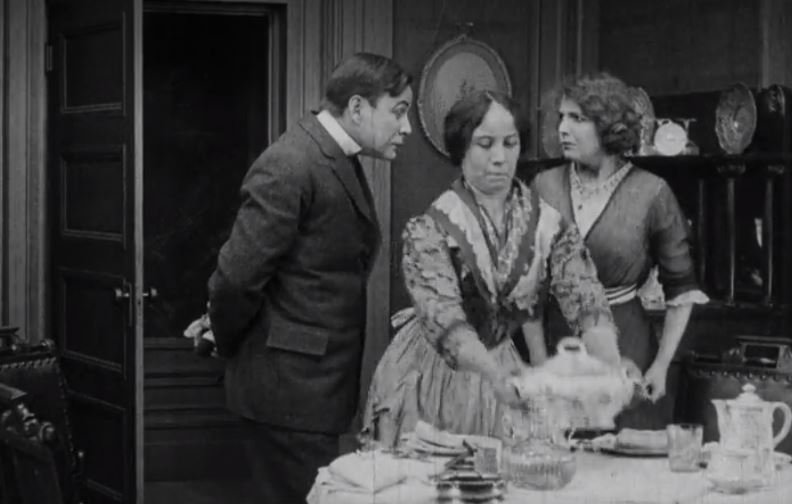
A House Divided (Alice Guy, 1913)
A House Divided is an especially intelligent and charmingly humorous film by Alice Guy, one of the first film directors to work with fiction. A happily married couple almost breaks up because of unfounded jealousy – this film displays Guy’s talent at constructing a classical comedy of errors, her sense of close shots, and her special interest in making sound palpable with visual motifs.
As a future programmer, I find it an ambiguous and challenging project to work with the films of Alice Guy. As we know, women were excluded from the decisive positions of filmmaking from the beginnings of film history. No other method of production functions more strictly in accordance with a capitalist logic than feature-length fictions thus it was particularly dominated by the oppressive nature of male chauvinist society. Certain positions that were deemed suitable for women, but it was hardly possible for a woman to be trusted with the responsibility of a director, especially after film would acquire the reputation of an artform or source of major income.
As far as lasting fame is concerned, Alice Guy is among the lucky ones. Some women were literally erased from the history of film. For me, Hungarian director Kornai Margit strikingly exemplifies this kind of exclusion. Beginning her career in show business an actress, Kornai quickly achieved great success. After the unfortunate death of her first husband, she became the director of a theatre they had owned, then with her second husband she started to invest in film production. They founded Astra film company, where Kornai, a literary reader of vast knowledge, looked for screenplay materials but she also worked as screenwriter and director. Although she was credited for various production activities, she did not get a single credit for directing. It took a tireless research to prove that a number of films credited to her husband were, in fact, directed by her. (Research of Hussein Evin on Kornai Margit: https://www.youtube.com/watch?v=4ZWv7tGG–4)
Alice Guy directed more than four hundred films and, fortunately, in most cases her directorial position is confirmed or even credited. Notwithstanding, her name hardly appears among the giants of film history in books and encyclopaedia. She has been clearly left out from many major tastemakers’ personal canon.
While there are lot of depressing tendencies in our contemporary film culture in general, the increasing importance of subcultures is quite liberating because it gives space for fragmented, impure and minor tastes and canons. As individuals, we belong to a lot of subcultures – with diverse canons – at the same time, which sometimes overlap, mostly contradict but always reinforce each other’s entitlement. This phenomenon allows us to think critically and prevents the concept of a mainstream canon. Given this context, it is still difficult to get close to an artist like Alice Guy.
While figures like her cannot be integrated into our canons without reflecting upon the hardships they might have had throughout their careers, I find it disturbingly controversial that most of the discourses highlight that Alice Guy was a woman, and not the artistic values of her work. An essential example would be any kind of text – and there is a lot – based on the comparison of Alice Guy and male filmmakers, as if art was a competition, or, in other cases, essays focusing on how forgotten she is.
Another instant of this regressive attitude appears in the movie Be Natural: The Untold Story of Alice Guy-Blaché (Pamela B. Green, 2018). This film presents itself as it was the first attempt to reveal the crucial part Alice Guy had in film history, even though the film itself acknowledges the numerous existing publications and biographies about her. In 2018, the case of not knowing Alice Guy is not a result of misogynistic canonization – as it was demonstrated in the movie asking different directors and producers whether they heard of the director – just the outline of different fields of interest and the ignorance of Hollywood people, which should not be surprising. If these people were interested in the history of silent film, they would certainly know about Alice Guy, as even in Hungary it was easy to bump into her name. Of course, I would not deny that she is less well-known than some of the male directors of her time, however I doubt that the above-mentioned industry people could name a large number of silent film directors. With this sonorous title suggesting that Alice Guy is a hidden gem, the filmmakers provide a false image and push her back to the vague margins of film history.
Obviously, the attempt to rediscover female directors from time to time is nice and righteous, and programming films made by women or featuring women are both valid ways of this practice. We, people, politics, society, culture are constantly rewriting film history, and this time women must have a self-evident place in it. The context of presenting Alice Guy’s oeuvre might be recontextualizing, but we cannot reduce the artist’s importance on being a woman.
Rewatching this film made me think of new possible contexts for it. Besides, I wish to take the opportunity to focus a little more on the film, in order to avoid committing the above-described mistake.
For me, the most interesting take would be to focus on sounds and noises in silent cinema, showing the ways of making the audience percept the sound. In this film, the actors always turn towards the public when they make an exaggerated gesture marking a noise or loud sound – for instance the scene of the husband interrupting the wife’s piano play or the secretary dropping down dossiers on the floor in the office –, as if they reminded us, the public, on the pact we made on sound effects. Just to mention another technique, Edwin S. Porter’s Life of an American Fireman (1903) uses close-ups and a circle frame to add a pseudo-auditive character to the ringing alarm. Alice Guy involves our sense of smell as the misunderstood trace of the husband’s affair is the scent of a perfume, and this might bring up films like Charlie Chaplin’s City Lights (1931) with the famous scene of smelling a rose.
One could also present A House Divided as a fascinating comedy of errors, which is still a primary source of humour. From Guy’s contemporaries, Max Linder may come to mind as an evident figure in the battle of sexes, but this remarkable short could also be shown next to Some Like it Hot (Billy Wilder, 1959) or Desperately Seeking Susan (Susan Seidelman, 1985), as just two well-known examples of this rich and diverse tradition. In case of Alice Guy the situation of the man and the woman form a dialogue. The director empathizes with both characters as they are both victims of a confusing situation, and especially stresses the woman’s emotions while eavesdropping her husband talking to the lawyer.
An unexpected turn of events sorts out this complex network of misunderstandings. It is a frequent way of resolving complicated situations in the beginnings of silent film era, and it might be interesting to investigate through watching films of this kind together whether these deus ex machina situations have a social or cultural dimension. It can either be understood as an early example of dissolving a tangled narrative or an attribute of slapstick comedies. In A House Divided the latter happens, a surprising and funny misunderstanding compensates and resolves all the former complications. Among others, an aesthetically truly different example could be a much later film, Der letzte Mann (Friedrich Wilhelm Murnau, 1924), which is an exceptional case of the deus ex machina technique.
It always amazes me how such a short and dense film covers so many questions, themes and issues and it’s highly enjoyable demonstration of Guy’s artistry.

 Babos Anna